It wasn't until I was researching for this blog entry that I realised that Amano is also a photographer. I had assumed that the pictures in his books were taken by someone else, but I have now discovered that he is highly regarded for his professional photography as well as his aquascaping skills. His website is here.
My purpose here is to talk about Amano's aquascapes, photographs of which can be seen here. The photographs are of a technically high standard - I know from experience that aquarium photography is far from easy, due to the problems of reflection, movement and sometimes low light. What interests me more, though, is the composition of the planting. Amano is recognised as using the Golden Ratio within his designs. This is an oft-talked about technique used by photographers too, so I suppose it is natural that Amano should be a photographer.
Just as with a photograph, Amano recognises that aquascapes are most appealing and soothing to view if they include an 'anchor' - an eyecatching focal point that draws the viewer's gaze immediately. In an aquarium, this could be, for instance, a red-leaved plant amongst predominantly green plants, an interesting rock or a piece of driftwood. In most of his designs, this focal point is purposefully placed according to the Golden Ratio. This draws the viewer's gaze without their eyes wandering to the sides of the tank with nowhere to settle. From this point, the viewer can then begin to explore the rest of the scene.
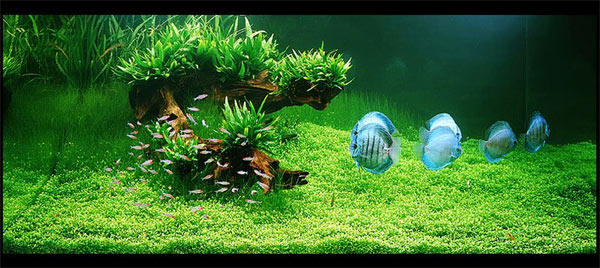
In this example (source), the driftwood sits on the 1: 1.6 Golden Ratio:
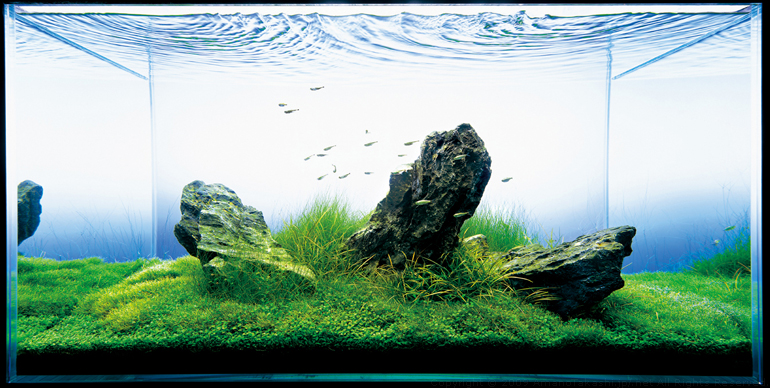
Here is another example (from Amano's website):
When I first started snapping photographs as a child, I did what so many people do - stuck the main subject in the centre of the frame and didn't really think about composition at all. Later, when I became more interested in photography for art's sake, rather than just 'snapshots', I read about the Rule of Thirds. This now comes naturally to me when composing photographs, and I do not necessarily have to give conscious thought to it.
In photography magazines, on websites and in books, I have often seen words to the effect of "the Golden Ratio, also known as the Rule of Thirds..." which implies that they are exactly the same. However, there are differences. At present, I have to give conscious thought to the Golden Ratio, and think about how elements in the frame relate to one another. With practice, however, I hope I will be in a position where framing in this way comes more naturally to me. I can then give more of my attention to ensuring that elements such as lighting and viewpoint are the way I would like them.
I would strongly urge anyone reading this to take a look at Amano's aquascapes. Even if aquarium fish are not your 'thing', I feel that his aquariums are beautiful, and that his placement techniques are equally relevant to photography.

There is something particularly attractive about a well thought out and maintained aquarium.
ReplyDeleteI think it's true that we can never look at too much art - even if it's not the particular art we're studying. all the forms have something useful to say.